
How to Handle Bunions at Home (With Our Help!)
Notice a hard, bony bump forming at the base of your big toe? Or maybe your favorite shoes are suddenly far too tight, and walking long distances leaves your feet throbbing?
Many people assume this painful problem is simply a callous or a random growth of extra bone. In reality, a Bunion (Hallux Valgus) is a structural deformity.
Ignoring it will only make the problem worse, but many patients find that simple, straightforward management techniques can provide serious relief. Keep reading for Batavia Foot Care’s guide to spotting the signs and handling bunion pain at home.
What is a Bunion, anyway?
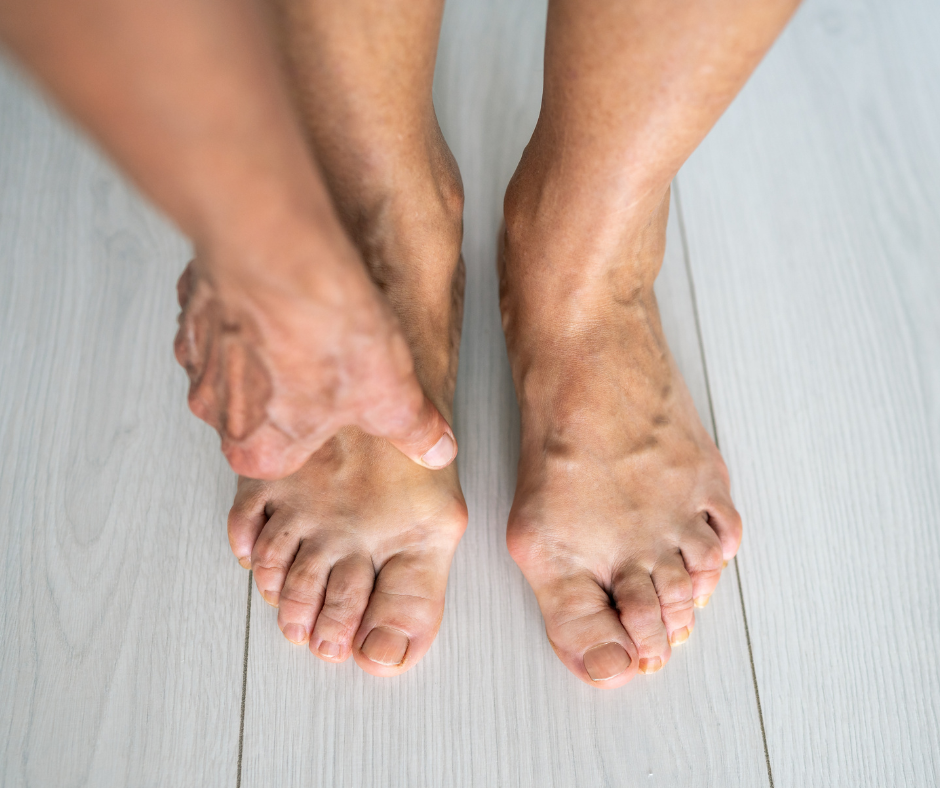
When the weight of your body falls unevenly on the joints and tendons in your feet, the long bone of your foot shifts outward, while your big toe leans inward.
- That “bump” around your metatarsophalangeal (MTP) joint is the head of your own bone protruding out of alignment.
- Left untreated, bunions can cause severe pain and hinder your ability to walk.
Because the MTP joint is critical for bearing and distributing your body weight, ignoring a bunion forces you to change your gait to relieve the pressure, which often leads to secondary pain in your knees and lower back.
That covers what a bunion is. But it doesn’t explain why people develop them!
The Blame Game: Genetics vs. Shoes
Who gets bunions? While they are an incredibly common problem that most women deal with, men frequently develop them, too.
The root cause is usually a combination of two factors:
- Genetics: Most people inherit a specific foot type or mechanical deformity (like flat feet) that makes their joints naturally unstable and prone to drifting.
- Footwear: Wearing poor-fitting shoes (especially those that are narrow, tight, or sharply pointed) squeezes that unstable joint into an unnatural angle, accelerating the deformity.
It’s Not Just the Big Toe: Types of Bunions
While standard bunions on the big toe are the most famous, the same mechanical failures can cause bumps in other areas of the foot. The most common variations include:
- Tailor’s Bunion (Bunionette): This occurs on the exact opposite side of the foot. The fifth metatarsal bone expands outward, forming a painful, bony growth near the little toe (the pinky toe).
- Adolescent Bunion: Bunions aren’t just for adults. Teenagers with unstable foot mechanics can develop a bunion at the base of their big toe.
- This can worsen over time and limit their participation in sports without proper intervention!
- Acute Bunion: This condition causes sudden, painful bony masses to form near the toe joints because of bursitis (severe inflammation of the fluid-filled sac protecting the joint).
How We Treat Bunions (Without Surgery)
Bunions are progressive, meaning they will not reverse themselves on their own. However, if we catch the deformity early, our healthcare providers can utilize conservative methods designed to limit the progression of the bunion, relieve pain, and restore function.
Our most common conservative approaches include:
- The “Shoe Choice” Audit
We will guide you toward footwear that respects your anatomy. Choose shoes with wide insteps, broad, square toe boxes, and soft soles. Avoiding shoes that forcefully taper at the toes is your first line of defense.
- Custom Orthotics
To relieve pressure from the affected areas and stop the mechanical collapse that causes the bunion to grow, we prescribe custom shoe inserts. These medical devices act as a scaffold for your arch, distributing your weight evenly and stabilizing the MTP joint.
- Protective Forefoot Products
We can prescribe or recommend specific products like bunion shields, night splints, or specialized bunion bandages. These tools offload the painful friction between your bone and your shoe, providing a healthy, protected environment for the foot to heal from daily inflammation.
Battle the Bump and Get Back to Moving Forward!
Bunions are a condition, not a sentence. They can be managed! If you’re affected and searching for solutions, ask us for more information about your structural alignment during your next consultation. We will get you back to walking comfortably.
You can always count on Batavia Foot Care Center to care for your feet using a full range of therapies and treatment options. Dr. Dawn K. Dryden serves patients of all ages in Batavia, New York. Contact our office to schedule an appointment!
